Last Updated: February 2026
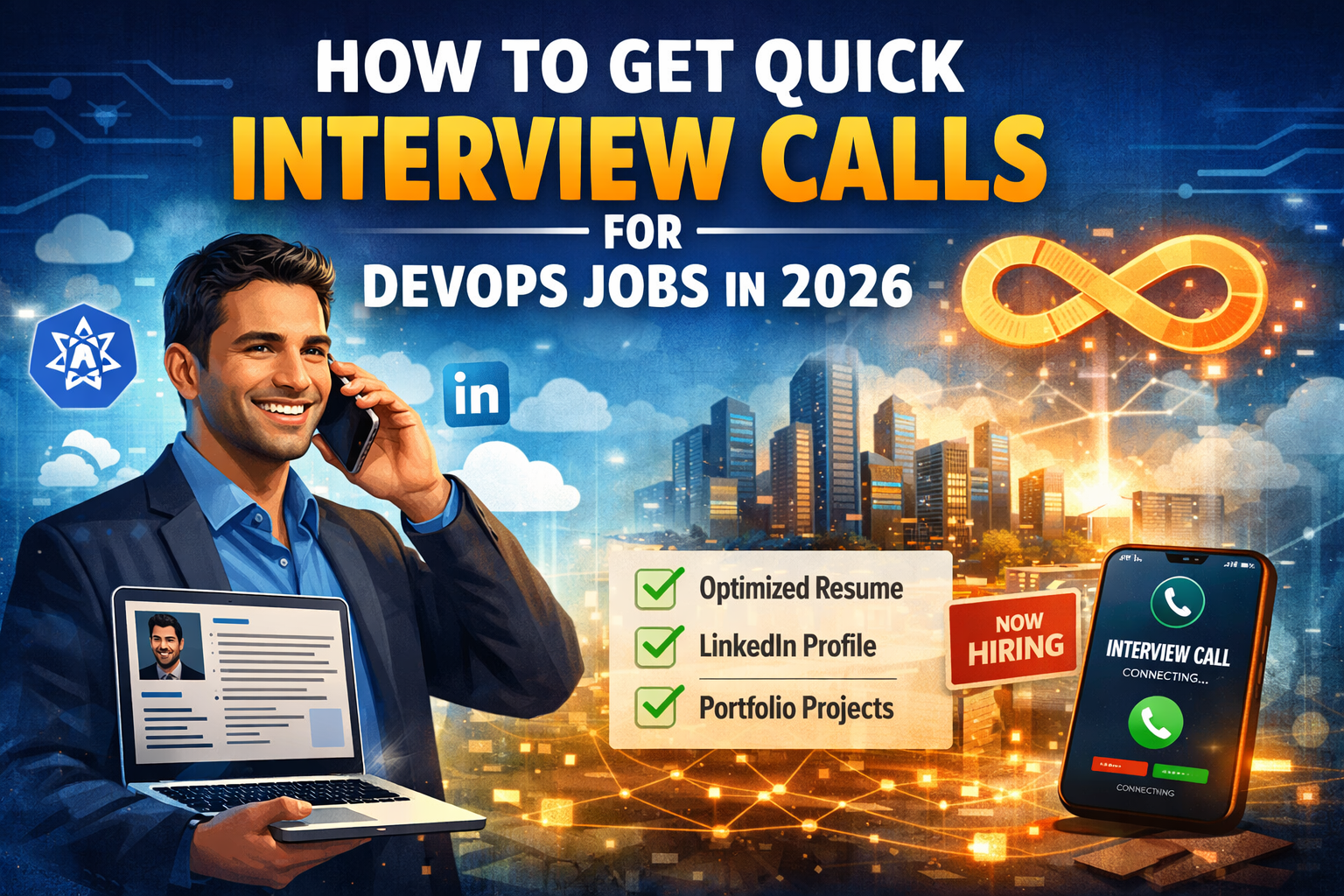
Want to get DevOps interview calls in 2026? This proven strategy shows you exactly how to optimize your resume, LinkedIn profile, and portfolio to land interviews faster. Real tactics that actually work.
Look, I’m just going to be straight with you.
Getting DevOps interview calls for DevOps roles in 2026 isn’t about applying to 500 jobs and hoping something sticks. I’ve seen too many talented engineers do this and burn out. The truth? It’s about making yourself so visible and valuable that recruiters can’t ignore you.
After helping dozens of DevOps engineers land their dream roles (and going through this journey myself), I’ve cracked a system that consistently gets results. We’re talking interview calls within 48-72 hours of applying, sometimes even getting cold-messaged by recruiters.
Here’s the exact strategy that works.
Why Most DevOps Engineers Struggle to Get Interview Calls

Before we dive into the solution, let’s talk about why your applications might be disappearing into a black hole.
The brutal reality: Most DevOps job postings get 200+ applications. Your resume has about 6 seconds to make an impression before it’s tossed. And here’s the kicker – 75% of resumes never even reach human eyes. They’re filtered out by Applicant Tracking Systems (ATS) before a recruiter even sees them.
But there’s more to it. The DevOps field has evolved. In 2026, just knowing Docker and Kubernetes isn’t enough. Companies want proof that you can:
- Reduce deployment time
- Cut infrastructure costs
- Improve system reliability
- Actually collaborate with dev teams (not just say you do)
The engineers getting multiple interview calls aren’t necessarily more skilled. They’re just better at communicating their value in a language that recruiters and ATS systems understand.
The 3-Pillar Strategy for Getting DevOps Interview Calls Fast

Pillar 1: Your Resume – The ATS-Beating Machine
Your resume needs to do two jobs: beat the robots and impress the humans. Here’s how.
Use Impact-Driven Metrics (Not Task Lists)
This is where most people screw up. They write:
- “Managed Kubernetes clusters”
- “Implemented CI/CD pipelines”
- “Worked with AWS services”
Cool. So did everyone else.
Instead, write like this:
- “Reduced deployment time from 2 hours to 12 minutes by implementing GitLab CI/CD with automated testing, enabling 40+ daily deployments”
- “Cut AWS costs by 34% ($28K annually) by rightsizing EC2 instances and implementing auto-scaling policies”
- “Improved system uptime from 98.5% to 99.8% by implementing Prometheus monitoring and automated incident response”
See the difference? Numbers tell a story. They show impact, not just activity.
The Perfect DevOps Resume Structure for 2026
Header Section:
- Full name
- Phone number
- Email (use a professional one, please)
- LinkedIn URL
- GitHub/GitLab profile
- Portfolio website or blog (if you have one)
Summary/Profile (3-4 lines max): Skip the “passionate DevOps engineer seeking opportunities” nonsense. Instead: “DevOps Engineer with 5+ years automating infrastructure and CI/CD pipelines. Reduced deployment failures by 67% at TechCorp through infrastructure-as-code and comprehensive monitoring. Specialized in AWS, Kubernetes, and Terraform with a focus on cost optimization and reliability.”
Skills Section (ATS Gold): List your skills in categories. This is where you beat the ATS.
Core Technologies: AWS (EC2, S3, RDS, Lambda, ECS), Azure, GCP, Docker, Kubernetes, Linux (Ubuntu/RHEL)
CI/CD & Automation: Jenkins, GitLab CI, GitHub Actions, CircleCI, ArgoCD, Terraform, Ansible, Puppet
Monitoring & Logging: Prometheus, Grafana, ELK Stack, Datadog, CloudWatch, Nagios
Programming/Scripting: Python, Bash, Go, YAML, PowerShell
Other: Agile/Scrum, Git, Jira, Confluence
Experience Section: For each role, follow this formula:
- Company name, Job title, Duration
- 2-3 line context about the company/team
- 4-6 bullet points with metrics
- Technologies used (in parentheses)
Example: Senior DevOps Engineer | FinTech Startup | Jan 2023 – Present
Leading infrastructure automation and CI/CD initiatives for a high-growth fintech platform processing $50M+ in monthly transactions.
- Architected and implemented Kubernetes-based microservices platform, reducing infrastructure costs by 42% while improving scalability (AWS EKS, Terraform, Helm)
- Built end-to-end CI/CD pipeline with automated testing and security scanning, decreasing deployment time from 4 hours to 18 minutes (GitLab CI, SonarQube, Trivy)
- Established comprehensive monitoring and alerting system, reducing MTTR from 45 minutes to 8 minutes (Prometheus, Grafana, PagerDuty)
- Mentored 3 junior DevOps engineers, creating internal documentation and best practices that improved team velocity by 30%
ATS Optimization Checklist
- [ ] Use standard section headers (Experience, Skills, Education)
- [ ] Save as .docx or .pdf (most ATS systems prefer .docx)
- [ ] Avoid tables, images, and fancy graphics
- [ ] Include keywords from the job description naturally
- [ ] Use standard fonts (Arial, Calibri, Times New Roman)
- [ ] Don’t use headers/footers for important info
- [ ] Spell out acronyms at least once (CI/CD – Continuous Integration/Continuous Deployment)
Pillar 2: LinkedIn – Your 24/7 Recruiter Magnet
Here’s something crazy: 87% of recruiters use LinkedIn to find candidates. But most DevOps engineers treat their LinkedIn like a digital resume they update once a year. Big mistake.
Your LinkedIn should be a living, breathing advertisement of your expertise.
Optimize Your LinkedIn Profile for Recruiter Searches
Headline (120 characters of pure value): Bad: “DevOps Engineer at Company XYZ” Good: “DevOps Engineer | AWS & Kubernetes Expert | Reducing Costs & Improving Reliability | CI/CD Automation”
About Section (Tell Your Story): This is NOT your resume summary. Write like you’re talking to a colleague at a conference. Here’s a framework:
“I got into DevOps kind of by accident. I was a sysadmin tired of manual deployments, and I started automating everything. Fast forward 7 years, and I’ve helped companies deploy code 100+ times a day without breaking production.
What gets me excited? Taking a deployment process that takes hours and turning it into a 10-minute automated workflow. Or looking at a $50K AWS bill and finding ways to cut it in half without sacrificing performance.
I specialize in: 🔹 Cloud Infrastructure (AWS, Azure, GCP) 🔹 Kubernetes & Container Orchestration 🔹 CI/CD Pipeline Automation 🔹 Infrastructure as Code (Terraform, CloudFormation) 🔹 Monitoring & Incident Response
Currently working on [current project or focus area]. Always happy to connect with fellow DevOps folks or companies looking to level up their infrastructure game.
Let’s connect!”
Experience Section: Same as resume, but you can be more conversational. Add media:
- Screenshots of dashboards you built
- Architecture diagrams
- Links to blog posts about projects
Skills Section: Add ALL relevant skills. Then:
- Get endorsements (ask colleagues, give endorsements to get them back)
- Reorder skills to put most important ones first
- Take LinkedIn skill assessments and display badges
Recommendations: Aim for 3-5 recommendations from:
- Former managers
- Colleagues you worked closely with
- Developers you supported
Don’t have any? Reach out and offer to write one for them first.
The LinkedIn Activity Strategy
Here’s where most people drop the ball. Having a great profile isn’t enough – you need to be VISIBLE.
Post 2-3 times per week:
- Share a DevOps tip or lesson learned
- Comment on industry news
- Post about a problem you solved
- Share useful tools or resources
Example post: “Just cut our deployment time from 45 minutes to 6 minutes.
The fix? We weren’t using Docker layer caching properly in our CI pipeline. By reordering our Dockerfile and caching dependencies separately, we saved 39 minutes per build.
Small optimization, massive impact when you’re deploying 30+ times a day.
What’s your favorite CI/CD optimization trick? 🚀”
Engage with others:
- Comment on posts from DevOps influencers
- Join DevOps groups and participate
- Answer questions in your areas of expertise
Set your profile to “Open to Work”: Use the private setting if you’re employed. Recruiters can see it, but your current employer can’t.
The Recruiter Outreach Strategy
Don’t just wait for recruiters to find you. Go find them.
- Search for DevOps recruiters in your target companies
- Send personalized connection requests
- Follow up with a brief message about your interest
Template: “Hi [Name], I see you’re hiring DevOps engineers at [Company]. I’ve been following [Company’s] work in [specific area] and I’m really impressed by [specific thing].
I’ve spent the last 5 years building scalable infrastructure and CI/CD pipelines, with a focus on [your specialty]. Would love to chat about how I could contribute to [Company’s] team.
My background: [2-3 line summary with metrics]
Happy to share my portfolio or jump on a quick call. Thanks!”
Pillar 3: Portfolio – The Proof of Your Skills
This is your secret weapon. While everyone else is just claiming they know Kubernetes, you’re going to SHOW it.
Build a Public DevOps Portfolio
Option 1: GitHub/GitLab Projects
Create 3-5 portfolio projects that showcase real-world scenarios:
- Infrastructure as Code Project
- Full AWS/Azure/GCP infrastructure using Terraform
- Include VPC, security groups, load balancers, auto-scaling
- Add README explaining architecture decisions
- CI/CD Pipeline Demo
- Sample application with complete CI/CD pipeline
- Automated testing, building, and deployment
- Use GitLab CI or GitHub Actions
- Include deployment to Kubernetes
- Monitoring & Observability Setup
- Prometheus + Grafana monitoring stack
- Custom dashboards
- Alert configurations
- Document your alerting strategy
- Kubernetes Deployment
- Multi-service application on Kubernetes
- Include deployment, services, ingress
- Helm charts
- Horizontal pod autoscaling
- Automation Scripts
- Python/Bash scripts for common DevOps tasks
- AWS cost optimization script
- Log analysis tool
- Backup automation
Pro tip: For each project, include:
- Clear README with problem/solution/impact
- Architecture diagrams
- Screenshots or GIFs of it working
- Instructions to run it locally
Option 2: Personal Blog/Website
Having a blog where you document your DevOps journey is GOLD. Here’s why:
- Shows you can communicate complex topics
- Demonstrates continuous learning
- Gives you content to share on LinkedIn
- Makes you memorable to recruiters
Blog post ideas:
- “How I Reduced Our AWS Bill by 40%”
- “5 Kubernetes Mistakes I Made (And How to Avoid Them)”
- “Setting Up a Production-Ready CI/CD Pipeline in 30 Minutes”
- “Monitoring Best Practices I Learned the Hard Way”
You don’t need to be a great writer. Just share what you learned and how you solved problems.
Option 3: YouTube/Tutorial Content
If you’re comfortable on camera, short tutorial videos are incredibly valuable:
- 5-10 minute DevOps tutorials
- Architecture walkthroughs
- Tool comparisons
- Problem-solving videos
The Job Application Strategy That Actually Works

Now that your resume, LinkedIn, and portfolio are dialed in, here’s how to apply for maximum interview calls.
Target Your Applications
Stop spray-and-pray. Instead:
- Make a target list of 20-30 companies you actually want to work for
- Research each company: What’s their tech stack? What problems are they solving?
- Find the hiring manager or team lead on LinkedIn
- Customize your resume for each application (yes, really)
- Apply and immediately follow up with a connection request
The Follow-Up Sequence
Day 1: Apply through their system Day 2: Connect with the hiring manager on LinkedIn with a note Day 3: Connect with DevOps team members Day 5: If no response, send a brief email to the hiring manager
Email template: Subject: DevOps Engineer Application – [Your Name]
Hi [Name],
I applied for the DevOps Engineer role at [Company] a few days ago (Application #[if you have it]).
I’m particularly excited about this role because [specific reason related to their tech/mission]. In my current role at [Company], I’ve [brief relevant achievement with metric].
I’d love to discuss how my experience with [relevant tech] could help [Company] [achieve specific goal].
Here’s my portfolio with examples of my work: [link]
Would you have 15 minutes for a quick call this week?
Best, [Your Name]
Where to Find the Best DevOps Jobs in 2026
Don’t just rely on LinkedIn and Indeed. Here are the best places to find DevOps roles:
Job Boards:
- LinkedIn Jobs (obviously)
- Indeed
- Dice (tech-specific)
- Stack Overflow Jobs
- AngelList (for startups)
- WeWorkRemotely (remote roles)
- RemoteOK
- Hacker News “Who’s Hiring” monthly thread
Company Career Pages:
- Apply directly on company websites
- Set up alerts for DevOps positions
Recruiter Relationships:
- Build relationships with tech recruiters
- They often have unadvertised positions
Networking:
- DevOps meetups (virtual and in-person)
- CNCF and Kubernetes community events
- HashiCorp user groups
- AWS/Azure user groups
- Local DevOps conferences
The 30-Day Sprint to Interview Calls
Here’s a realistic timeline if you implement everything:
Week 1:
- Revamp resume with metrics and ATS optimization
- Update LinkedIn profile
- Set profile to “Open to Work”
- Start planning portfolio projects
Week 2:
- Build first 2 portfolio projects
- Write detailed READMEs
- Start posting on LinkedIn (2-3 posts)
- Create target company list
Week 3:
- Complete remaining portfolio projects
- Start blog (write first 2 posts)
- Begin targeted applications (5 per day)
- Connect with recruiters and hiring managers
Week 4:
- Continue applications and follow-ups
- Post consistently on LinkedIn
- Engage with DevOps community
- Refine based on feedback
Realistic expectations:
- Week 1-2: Probably quiet
- Week 3: First interview requests start coming
- Week 4: Multiple conversations happening
Advanced Tactics for Standing Out

Certifications That Actually Matter
Not all certs are created equal. Here are the ones that actually help in 2026:
High ROI:
- AWS Certified Solutions Architect (Associate or Professional)
- Certified Kubernetes Administrator (CKA)
- Certified Kubernetes Application Developer (CKAD)
- HashiCorp Certified: Terraform Associate
- AWS Certified DevOps Engineer – Professional
Nice to Have:
- Azure DevOps Engineer Expert
- Google Cloud Professional Cloud DevOps Engineer
- Certified Jenkins Engineer
Skip:
- Generic “DevOps Foundation” certs
- Anything not vendor-specific or widely recognized
Build in Public
Share your learning journey:
- Tweet about problems you’re solving
- Write LinkedIn posts about lessons learned
- Create short video tutorials
- Contribute to open-source DevOps tools
This does two things:
- Builds your personal brand
- Demonstrates continuous learning
Contribute to Open Source
Even small contributions to DevOps tools show:
- You can read and write production-quality code
- You understand how tools actually work
- You’re engaged with the community
Good projects to contribute to:
- Terraform providers
- Kubernetes ecosystem tools
- Jenkins plugins
- Prometheus exporters
- Ansible modules
Start with documentation improvements or bug fixes. Work your way up to features.
Common Mistakes That Kill Your Interview Chances
Let me save you some pain. Here are mistakes I see all the time:
Resume Mistakes:
❌ No metrics or impact statements ❌ Just listing technologies without context ❌ Generic objective statements ❌ Unexplained employment gaps ❌ Typos and grammatical errors ❌ Going over 2 pages (unless 10+ years experience) ❌ Using buzzwords without substance
LinkedIn Mistakes:
❌ Incomplete profile ❌ No profile photo (or unprofessional one) ❌ Not posting or engaging ❌ Generic connection requests ❌ Ignoring recruiter messages ❌ Not showcasing projects or achievements
Application Mistakes:
❌ Applying to everything without targeting ❌ Not customizing resume for each role ❌ Ignoring job requirements ❌ Not following up after applying ❌ Poor email communication ❌ Not researching the company
What to Do When You Start Getting Interview Calls

Congratulations! Your strategy is working. Now don’t screw it up.
Immediately:
- Respond within 24 hours (ideally within 4 hours)
- Show enthusiasm but maintain professionalism
- Be flexible with scheduling
- Confirm the interview details
Interview Prep:
- Review the job description thoroughly
- Research the company’s tech stack
- Prepare specific examples using STAR method
- Prepare questions about their infrastructure
- Review your own projects so you can discuss them
During the Interview:
- Listen more than you talk
- Ask clarifying questions
- Use specific examples with metrics
- Show genuine interest in their problems
- Don’t badmouth previous employers
Follow Up:
- Send thank-you email within 24 hours
- Reference specific conversation points
- Reiterate your interest
- Provide any additional materials discussed
Frequently Asked Questions
How long should my DevOps resume be?
Keep it to 1-2 pages max. If you have less than 5 years of experience, stick to 1 page. More than 5 years? Two pages is fine, but make every line count. Remember, recruiters spend 6 seconds on your resume initially – make those seconds matter.
Should I include all technologies I’ve ever touched?
No. Only include technologies you’re comfortable being interviewed on. If you used Docker once three years ago, leave it off. Focus on skills you’ve used in the last 2-3 years and can speak confidently about. Quality over quantity.
Do I really need a portfolio if I have 7+ years of experience?
Yes, but it looks different. For senior folks, your portfolio can be:
- Blog posts about architecture decisions
- Open-source contributions
- Conference talks or presentations
- Technical documentation you’ve written
- System designs or architecture diagrams (sanitized/anonymized)
How do I explain employment gaps?
Be honest and brief. “Took time off to handle family matters” or “Personal sabbatical to upskill in Kubernetes and cloud technologies” works fine. Then pivot to what you learned or worked on during that time. Many people have gaps, especially post-2020. Recruiters are more understanding than you think.
Is it okay to apply for jobs I’m not 100% qualified for?
Absolutely. If you meet 60-70% of requirements, apply anyway. Job descriptions are often wish lists, not hard requirements. Companies would rather hire someone with 70% of skills who’s eager to learn than wait forever for a unicorn.
How many applications should I submit per week?
Quality over quantity. I’d rather see 10 highly targeted applications with customized resumes and follow-ups than 50 generic applications. Aim for 5-10 quality applications per week with proper research and customization.
What if I don’t hear back after applying?
Follow up after 5-7 days. If still no response after 2 weeks, move on. Don’t take it personally – there are a million reasons you might not hear back that have nothing to do with your qualifications. Keep applying and improving your materials.
Should I work with recruiters or apply directly?
Both. Good recruiters have relationships and can get your resume to the top of the pile. But also apply directly to companies you’re interested in. Multiple paths = more opportunities.
How often should I post on LinkedIn?
Aim for 2-3 posts per week for maximum visibility. Even 1 post per week is better than nothing. Quality matters more than quantity – share genuine insights, not just reposted content.
What’s the best time to apply for DevOps jobs?
Early in the week (Monday-Tuesday) and early in the day (before 10 AM) tend to get better response rates. Avoid Friday afternoons and weekends. January-March and September-October are typically peak hiring seasons.
Conclusion: Your Roadmap to DevOps Interview Success
Here’s the truth: getting quick interview calls isn’t about gaming the system. It’s about clearly communicating the value you bring and making it easy for recruiters and hiring managers to see it.
The three-pillar strategy works because:
- Your resume gets past the ATS and shows concrete impact
- Your LinkedIn makes you discoverable and demonstrates expertise
- Your portfolio provides proof that you can actually do the work
This isn’t a one-time thing. The DevOps engineers who consistently get the best opportunities are the ones who:
- Keep learning and sharing what they learn
- Build relationships in the community
- Document their work and wins
- Stay visible and engaged
Start small. Pick one pillar this week and improve it. Maybe that’s rewriting your resume with metrics. Or posting your first LinkedIn article. Or building that Terraform project you’ve been thinking about.
The market for skilled DevOps engineers in 2026 is still strong. Companies need people who can build reliable, scalable infrastructure. They need people who can bridge the gap between development and operations. They need you.
But they need to find you first.
Make it easy for them.
Now stop reading and start building. Your next interview call could be 48 hours away.
Additional Resources
External Resources
- AWS Well-Architected Framework
- Kubernetes Official Documentation
- Terraform Registry
- CNCF Cloud Native Interactive Landscape
- DevOps Roadmap
- Infrastructure as Code Best Practices
Internal Resources
About the Author
Kedar Salunkhe is a DevOps Engineer with 7+ years of experience building and scaling cloud infrastructure for startups and enterprises. He specializes in AWS, Kubernetes, and CI/CD automation, and has helped companies reduce deployment times by up to 85% while cutting infrastructure costs.
Kedar is passionate about helping fellow DevOps engineers level up their careers and shares practical insights from real-world infrastructure challenges. When he’s not automating deployments or optimizing cloud costs, he’s contributing to open-source DevOps tools and mentoring junior engineers.